Section 01
What is wallcovering, and how is it different from paint?
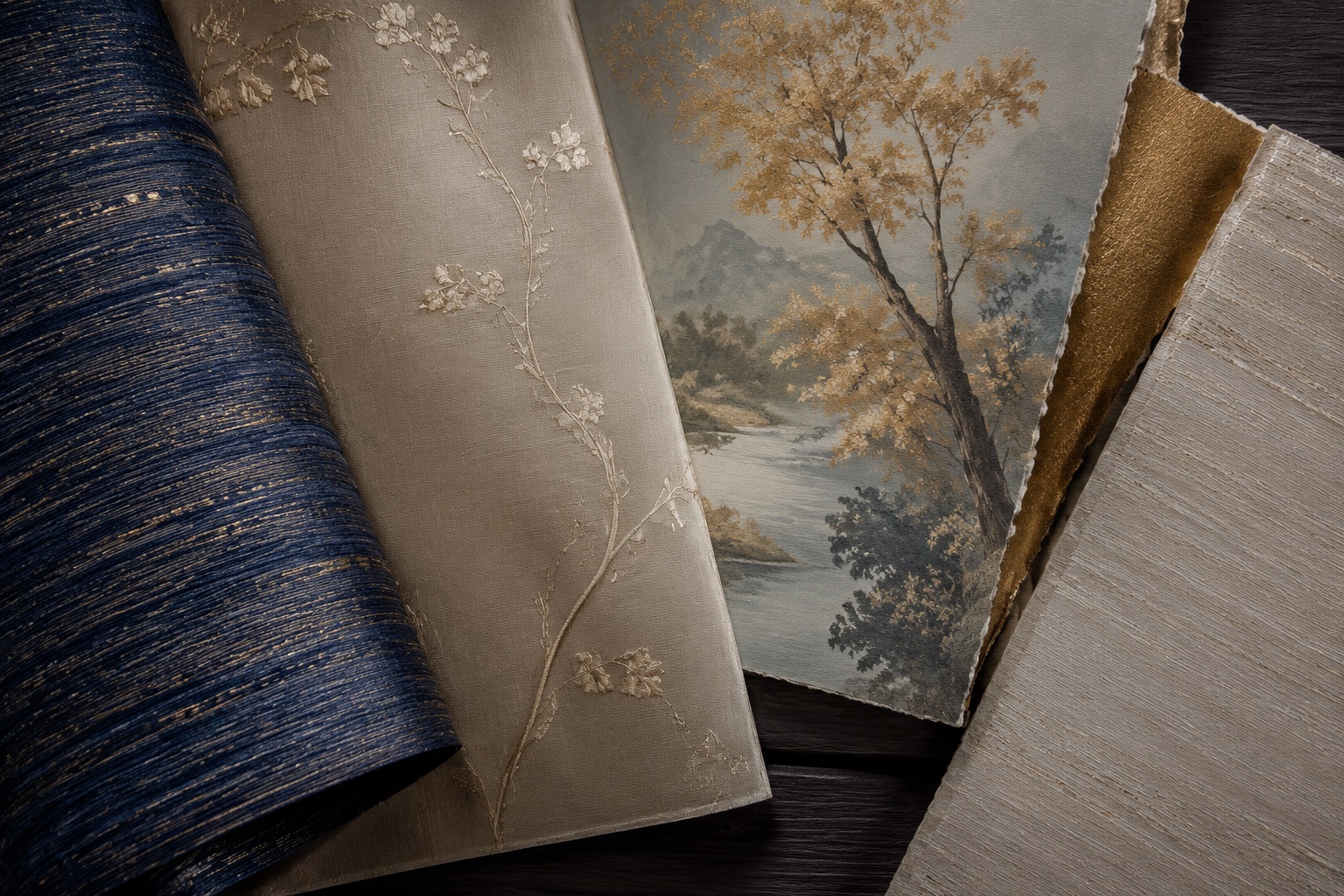
Wallcovering is any material hung on a wall in panels or rolls. Paint, by contrast, is applied as a liquid. The category runs from inexpensive printed vinyl at the low end to hand-painted silk and de Gournay scenics at the top, and the gap between those ends is enormous, both in material cost and in the skill it takes to install.
Most people say "wallpaper." In the trade that word is a loose umbrella. True paper is only one material in a much larger family. When a designer specifies "wallcovering," they usually mean something with a real substrate, a real face material, and a real repeat, not a peel-and-stick roll from a big-box store.
Two things separate wallcovering from paint, and both matter for a coastal Florida property. First, wallcovering adds texture and depth that paint cannot: the slub of a grasscloth, the sheen of a silk, the relief of an embossed panel. Second, the right wallcovering, installed correctly with the right adhesive and substrate prep, can outlast paint in a humid climate. The wrong one, trapped against a damp wall, will bubble, peel, and grow mildew within a season.
This guide walks every major material, what makes a wallcovering "luxury," where each belongs, and how we approach the ones that are too expensive or too delicate to risk. For the full service overview, see our luxury wallcovering and wall finishing page.
“The right wallcovering installed correctly can outlast paint in a humid climate. The wrong one trapped against a damp wall bubbles, peels, and grows mildew within a season.”
Section 02
Vinyl wallcovering: the workhorse (and its three tiers)
Vinyl is the most common wallcovering on the market because it is durable and forgiving to install, and it comes in three commercial tiers that decide where it belongs. Vinyl is a printed or embossed PVC face bonded to a paper, scrim, or non-woven backing. It resists moisture, scrubs clean, and takes traffic, which is why you see it in corridors, lobbies, and guestrooms more than anywhere else.
The commercial grades are defined by weight and durability:
- Type I (light duty, ~7–13 oz/sq yd) — guestrooms, offices, and low-traffic areas. Lighter, less abrasion-resistant. - Type II (medium duty, ~13–22 oz/sq yd) — corridors, lobbies, and public spaces. The hospitality workhorse. Most hotel wallcovering is Type II. - Type III (heavy duty, 22+ oz/sq yd) — high-abrasion zones like food-service back-of-house and healthcare. Rare in design-led spaces.
Residential "paper" sold as washable or scrubbable is usually a thin vinyl as well. It is the right call for a kid's bathroom or a rental. It is the wrong call for a formal dining room where you want the wall to read as a textile.
Vinyl is also where the humidity conversation gets nuanced. Solid vinyl is waterproof on its face, which sounds ideal for Florida. But that same waterproof face can trap moisture inside the wall if the substrate is damp or the building doesn't breathe. On exterior masonry walls in SWFL, a non-breathable vinyl over a damp wall is how you get mold behind the covering. The material is fine; the wall assembly decides whether it belongs. We install the full range of contract vinyl on our commercial wallcovering installation projects, and we make the breathability call before a single roll is ordered.
Section 03
Non-woven vs. traditional paper: which is easier to live with?
Non-woven is the modern, dimensionally stable substrate most quality wallcoverings are printed on today. Traditional paper is the older, more delicate material that moves with moisture. If you are choosing between them, non-woven is almost always easier to live with, though paper still has a place for certain printed and specialty goods.
Non-woven is a blend of natural and synthetic fibers, a breathable, fabric-like backing. It does not expand or shrink when wet, which means it can be installed "paste-the-wall": you roll adhesive directly onto the wall and hang the dry goods. That stability makes it more forgiving, faster to install, and easier to strip later, since it usually peels off dry in full sheets. It also tolerates humidity swings far better than paper. For most luxury printed and textured goods today, non-woven is the substrate of choice.
Traditional paper is exactly what it sounds like: a paper substrate, often with a printed or coated face. Paper expands when it absorbs paste and shrinks as it dries, which is why it has to be "booked." You paste it, fold it paste-to-paste, and let it rest so the material relaxes and expands fully before it goes on the wall. Skip or rush the booking time and the seams open as the paper dries. Paper is less forgiving, more vulnerable to humidity, and harder to remove, but it remains common for hand-printed and heritage goods where the face material demands it.
In coastal Florida, the substrate matters as much as the face. A dimensionally stable non-woven shrugs off the daily humidity cycle that makes a paper substrate creep at the seams. When a paper-backed material is the right aesthetic choice anyway, we account for it with proper lining, controlled site conditions, and disciplined booking. That is the kind of judgment our wallpaper installation service exists to provide.
“Non-woven shrugs off the daily humidity cycle that makes a paper substrate creep at the seams. In coastal Florida, the substrate matters as much as the face.”
Section 04
Grasscloth vs. vinyl: which should you choose?
Choose grasscloth when you want a wall that reads as a natural textile and you accept that it is delicate. Choose vinyl when you need durability, washability, and a forgiving surface. They are near-opposites, and most "grasscloth vs. vinyl" confusion comes from comparing a luxury natural fiber to a commercial workhorse as if they competed for the same job. They don't.
Grasscloth is a natural fiber, sisal, jute, arrowroot, hemp, or paperweave, hand-laid onto a paper backing. Every panel is woven from a living material, so color and weave vary panel to panel. That variation is the point. It is what gives grasscloth its hand and depth. It also means seams are visible by design: you do not "hide" a grasscloth seam, you balance the panels so the variation reads as intentional. The material stains if you wipe it with water, and it has to be hung with obsessive cleanliness, because paste on the face is permanent.
Here is the head-to-head, factor by factor:
Material — Grasscloth is natural plant fiber laid on paper; vinyl is printed or embossed PVC.
Look — Grasscloth reads as organic texture with panel-to-panel variation; vinyl is uniform and repeatable.
Seams — Grasscloth seams are visible by design and color-balanced by hand; vinyl seams can be made near-invisible when double-cut.
Durability — Grasscloth is delicate and stains with water; vinyl is washable, scrubbable, and traffic-rated.
Humidity — Grasscloth needs a dry, stable wall and a breathable mount; vinyl has a waterproof face but can trap moisture behind it.
Where it belongs — Grasscloth belongs in dining rooms, studies, primary suites, and feature walls; vinyl belongs in corridors, lobbies, baths, kids' rooms, and high-traffic spaces.
Install skill — Grasscloth is high-skill (clean hands, panel balancing, no overlaps); vinyl is moderate (double-cutting, pattern match).
Grasscloth is a designer's material and a homeowner's statement. Vinyl is the safe, washable choice for spaces that take abuse. Neither one is better than the other. The mistake is putting grasscloth in a steamy powder room, or specifying flat vinyl where the client wanted the wall to feel like raw silk.
“Most "grasscloth vs. vinyl" confusion comes from comparing a luxury natural fiber to a commercial workhorse as if they competed for the same job. They don't.”
Specifying grasscloth for a project?
Section 05
What are silk and textile wallcoverings, and why are they so demanding?
Silk and textile wallcoverings are real woven fabric, silk, linen, wool, or blends, laminated to a paper or acrylic backing and hung as wallcovering. They sit at the top of the material hierarchy because the face is literal cloth, which means it shows every flaw in the wall behind it and punishes any mistake in the hang. This is silk and textile wallcovering, and it is where installation skill stops being a convenience and becomes the entire job.
Three things make silk and textiles the most demanding goods we hang:
The face is unforgiving. A fabric face telegraphs every bump, ridge, and imperfection in the substrate. The wall has to be skim-coated dead flat and often lined with a blank stock first. Any adhesive that touches the face leaves a permanent shadow. Any seam that is overlapped instead of butted casts a visible line in raking light.
Repeats and railroading matter. Many silks and textiles have a directional weave or a subtle shade variation across the roll. Panels have to be sequenced, sometimes reverse-hung, and occasionally "railroaded" (hung horizontally) to keep the shading consistent across a wall. Get that wrong and it shows up as a banded, mismatched wall under the room's lighting.
Humidity is the enemy of natural-fiber face goods. Silk and many natural textiles can water-spot, and they react to the moisture that comes off an improperly cured plaster wall or a humid SWFL room. We control site conditions, prime and seal the substrate, and choose adhesives that won't bleed, because a single water mark on a silk panel means replacing the whole panel.
Several of the luxury lines we install and know cold — Phillip Jeffries, Fromental, de Gournay, Gracie, Scalamandré, Pierre Frey, Maya Romanoff — make goods in this category. These are materials too expensive and too delicate to learn on. That is the work we built our reputation around.
“With silk, installation skill stops being a convenience and becomes the entire job. A single water mark on a panel means replacing the whole panel.”
Section 06
Mylar, foil, flock, and embossed: the specialty wallcoverings explained
Mylar, foil, flock, and embossed papers are specialty goods. Each trades easy installation for a specific visual effect, and each one demands a near-perfect wall behind it. With these materials, surface prep, not the material itself, decides whether the result looks luxurious or cheap.
Mylar and foil have a reflective, metallic face: a polyester (mylar) or thin metal (foil) layer that bounces light. The effect is striking in a powder room, or in a dining room at night. The catch is that a reflective face shows every imperfection in the wall like a funhouse mirror. The substrate has to be lined and skim-coated to glass-smoothness, and the goods handled without creasing, because a crease in a metallic face is permanent and catches the light forever.
Flock is a raised, velvety pattern, historically powdered fibers fixed to the surface to imitate cut velvet. It has a deep, traditional richness, the look of a paneled library or a formal dining room. It is also fragile: the pile crushes if you press a roller over the pattern, and adhesive on the flock face cannot be cleaned off. Flock is hung with the seam roller kept off the raised design entirely.
Embossed and Anaglypta are paintable, high-relief papers with a raised texture pressed into the material. Anaglypta is the classic heavy-bodied embossed paper used for ceilings, below chair rails, and to add architectural relief to flat walls; once hung, it is typically painted. It is one of the more forgiving specialty goods to install and one of the most effective for adding period character to a renovation.
The common thread: specialty face goods are only as good as the wall behind them. Because we hold a Florida CBC general contractor's license (CBC 1258403), we can prep, line, skim, and rebuild that wall ourselves rather than hanging a $200-a-yard metallic over a substrate someone else left wavy.
Section 07
Murals, scenics, and hand-painted wallcovering: the top of the market
Murals, scenics, and hand-painted wallcoverings are panel-set, non-repeating artworks made for one specific wall, which puts them at the very top of the market: each set is effectively a one-off. Unlike a roll with a repeat, these come as a numbered sequence of panels that assemble into a single continuous image. There is no margin for error in measuring, sequencing, or hanging. This is murals, scenic, and hand-painted wallcovering, and it is the most exacting install we do.
A scenic (the classic example is a de Gournay or Gracie chinoiserie) is a continuous landscape that wraps a room: birds, branches, and blossoms that flow from panel to panel without a repeat. The panels are custom-sized to your wall heights, and the image is "set" to the room before printing or painting, so the focal elements land where the designer wants them. Get the wall measurements wrong and the artwork doesn't fit the wall it was made for.
A hand-painted wallcovering is exactly that: painted by an artisan on silk or paper, often gilded, sometimes painted further on-site to blend panels and touch in the joins. These can run into five and six figures for a single room. There is no "ordering another roll" if a panel is damaged.
What this category demands of an installer is obsessive measurement before a single panel is cut, dry-hanging and sequencing every panel before any adhesive touches the wall, butt seams that disappear into the artwork, and the judgment to hand off to (or coordinate with) the studio's own finishing artist when on-site touch-in is required. This is the top of our trade. Steve Cusimano began his craft at 21, hanging wallcovering in a prince's palace in Saudi Arabia. Forty-two years later, that same standard goes on every wall we touch.
“A scenic is set to the room before it's made. Get the wall measurements wrong and the artwork doesn't fit the wall it was made for.”
Have a scenic or hand-painted install coming up?
Section 08
Is peel-and-stick wallpaper any good?
Peel-and-stick wallpaper is fine for a rental, a quick refresh, or a temporary nursery. It is the wrong material for any wall you want to look high-end or last more than a few years. It is a self-adhesive vinyl or fabric-backed film that sticks directly to the wall with no paste, marketed as "removable" and "renter-friendly." For what it is, it works.
Here is where it falls short, and why no designer specifies it for a feature space:
- The seams show. Peel-and-stick doesn't butt and double-cut the way pasted goods do, so seams tend to be visible and lift over time. - It hates humidity and texture. On a SWFL wall, the adhesive lets go at the edges as temperature and humidity swing. On any wall that isn't perfectly smooth and clean, it never fully bonds. - The materials read as flat. A printed film cannot reproduce the depth of a grasscloth, the sheen of a silk, or the relief of an embossed panel. It photographs better than it lives.
If you want the look of luxury wallcovering, peel-and-stick is not a shortcut to it. It is a different, lesser product. The right move for a wall that matters is a real material on a properly prepped substrate, hung to butt seams that disappear. That is the difference between a wall that looks expensive and a wall that looks like it's trying to.
Section 09
What actually makes a wallcovering "luxury"?
A wallcovering is "luxury" when three things are true at once: the material is genuine (real fiber, real metal leaf, real hand-painting, not a print imitating them), the goods are made in limited or custom runs rather than mass-produced, and the install demands a master's hand rather than a roller and a level. Price follows from those three. It is not the cause.
Break it down:
Genuine material. Real silk, real grasscloth, real gold leaf, real hand-painting. A printed "faux grasscloth" vinyl can look convincing in a photo, but in person, and especially in raking light, the eye reads the difference between a printed texture and an actual woven one. Luxury is the real thing.
Limited or custom production. Scenics set to your room, colorways made to a designer's spec, hand-blocked prints in short runs. The opposite of a pattern you can buy by the truckload.
Install that protects the investment. This is the part owners underestimate. A $400-a-yard hand-painted silk installed by someone who has never hung one is a $400-a-yard mistake. The luxury isn't only in the roll. It is in the seams that disappear, the panels sequenced so the shading reads consistent, the substrate prepped so a metallic face is mirror-flat, the cleanliness that keeps paste off a porous face. Material this expensive is too expensive and too delicate to risk on a learning curve.
That last point is the whole reason this category exists as a specialty. Designers, hotels, and luxury homeowners come to a master installer precisely when the material is too valuable to hand to a general painter. For a side-by-side of where each material belongs, the comparison in the grasscloth-vs-vinyl section above is the fastest reference. To talk through a specific material on a specific wall, the next step is a conversation.
“The luxury isn't only in the roll. It's in the seams that disappear and the substrate prepped mirror-flat. Material this expensive is too delicate to risk on a learning curve.”
Section 10
How does Southwest Florida humidity change which wallcovering you should pick?
Coastal Florida humidity changes the answer to almost every "which wallcovering?" question, because the wall assembly, not just the face material, decides whether a covering survives. A material that performs perfectly in a dry climate can fail in a year against a damp SWFL exterior wall. A material that seems too delicate for Florida can do beautifully on the right interior wall with the right prep. The variable is moisture, and managing it is local knowledge.
The core issues, plainly:
- Trapped moisture. Non-breathable goods (solid vinyl, foil) over a wall that can take on moisture (exterior masonry, a wall over a slab, anything near a bathroom or a coastal envelope) can seal humidity into the assembly. That is how mold ends up behind a wallcovering. The fix is choosing breathable goods and substrates, or correcting the wall, before the covering goes on. - Seam creep on hygroscopic goods. Paper and natural-fiber substrates absorb and release moisture with the daily humidity cycle. Without dimensional stability, proper lining, and controlled install conditions, seams open. Non-woven substrates resist this. - Water-spotting on natural faces. Silk and untreated natural fibers can mark from condensation or off-gassing from an undercured plaster wall. Sealing the substrate and controlling site humidity during the install prevents it.
This is why we make the breathability and substrate call before specifying a material, not after a callback. We hold a Florida CBC general contractor's license (CBC 1258403), so when a wall needs more than a covering, drying out, re-skimming, lining, or a real rebuild, the same accountable team handles it. A wallcovering specialist who can also prep, build, and finish the wall is the right partner for a humid climate, and it is why designers, hospitality owners, and luxury homeowners across Southwest Florida bring us the walls that matter. Start with our luxury wallcovering and wall finishing overview, or call to talk through a specific space.
“A material that performs perfectly in a dry climate can fail in a year against a damp SWFL wall. The variable is moisture, and managing it is local knowledge.”