Section 01
Which wall finish is right — the short answer
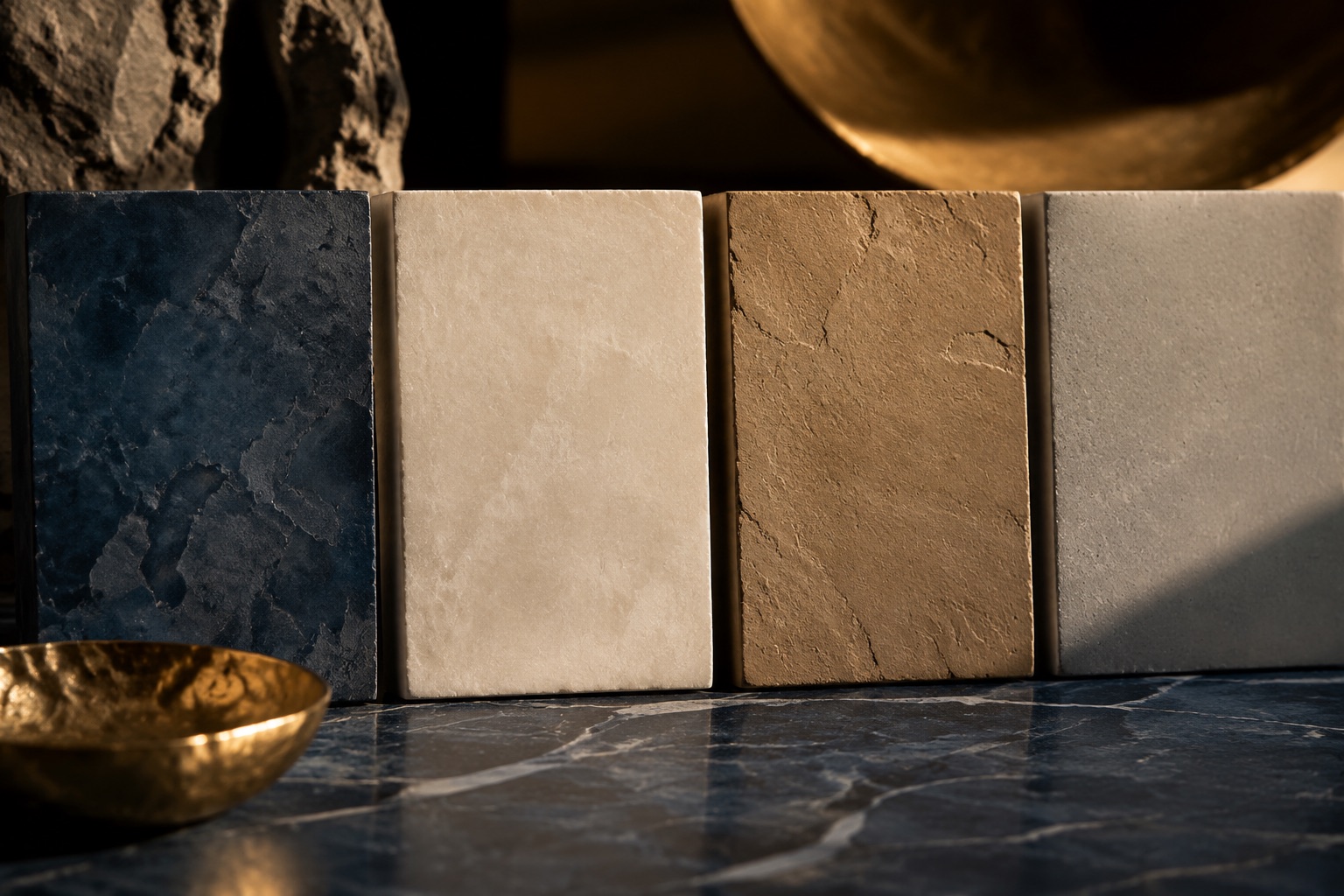
Pick by the look you want and the wall you're putting it on. Venetian plaster is for high-polish, marble-like feature walls and formal rooms. Limewash is for soft, matte, old-world depth with visible brush movement. Roman clay is for a suede-smooth matte that reads more contemporary and forgives an imperfect wall. Microcement is for a seamless modern surface that can run from the wall onto the floor, the shower, even the countertop.
All four are troweled or brushed on by hand. Three of them (limewash, Roman clay, and traditional lime-based Venetian) are breathable mineral finishes that let a wall release moisture instead of trapping it behind a film. In coastal Southwest Florida, that breathability decides whether a finish ages well or blisters off the wall.
The rest of this guide is the long answer: the comparison table, then each finish on its own terms, then a straight recommendation for our humidity. If you already know you want plaster and just need it installed correctly, start at the Specialty Wall Finishes hub.
“Pick by the look you want and the wall you are putting it on. Then check it against your climate before you fall in love with a sample board.”
Section 02
How the four finishes compare at a glance
Here is the whole decision on one screen. Look is what the eye reads. Durability assumes a correctly prepped substrate and a finish-appropriate sealer. Relative cost is installed, per square foot, low to high. The finish itself is rarely the expensive part; the prep and the labor hours are.
| Finish | Look | Where it works | Durability | Relative cost |
|---|---|---|---|---|
| Venetian plaster | Polished, marble-like depth with light-catching sheen | Foyers, formal rooms, feature walls, ceilings | High. Hardens to a stone-like surface; can be waxed for water resistance | $$$$ |
| Limewash | Soft matte with cloudy brush movement and tonal variation | Living spaces, bedrooms, fireplaces, old-world and Mediterranean interiors | Medium-high. Bonds chemically to masonry and lime substrates; cures harder over time | $$ |
| Roman clay | Suede-smooth matte, subtle troweled movement, more uniform than limewash | Modern and transitional rooms, halls, powder rooms, walls that need to read calm | Medium-high. Durable matte film; seal in wet or high-touch areas | $$$ |
| Microcement | Seamless, monolithic, minimal joints | Showers, wet rooms, floors, countertops, continuous wall-to-floor runs | Very high. Sealed cement composite rated for wet and high-traffic use | $$$$ |
A few honest caveats about any table like this. Cost depends far more on wall prep and square footage than on which finish you choose. The look of every one shifts with the installer's hand and the lighting in the room. And "durability" assumes the right sealer for the right exposure. A bathroom and a dining-room accent wall are not the same job, even with the same product.
Want a real sample on your wall before you commit?
Section 03
What is Venetian plaster, and when is it worth it?
Venetian plaster is a lime-and-marble-dust finish burnished in multiple thin coats until it reaches a polished, stone-like depth. Think of the cool sheen of honed marble, built up by hand on a flat wall. It is the most formal of the four finishes and the one most people picture when they hear "polished plaster."
Where it works. Foyers, dining rooms, formal living spaces, accent walls, and ceilings where you want light to move across the surface. Burnished and waxed, it can take a wet location like a powder room. For a steam shower you generally want a Tadelakt or microcement system instead.
Why it costs more. The premium is in the coats and the burnishing. A true Venetian finish is built in three to five passes, each troweled thin and left to set, then polished by hand. That is labor and craft hours, not material. The wall also has to be near-perfect underneath, because a high-polish surface shows every flaw the way a mirror does.
What we look for. Substrate flatness, the right number of coats for the depth you want, and a sealing strategy that matches the room. Done correctly, it is the closest a wall comes to looking like solid stone. Done by someone learning on your wall, it streaks and telegraphs the trowel.
If this is the look you're after, our Venetian plaster service covers prep, application, and sealing.
“A true Venetian finish is built in three to five hand-burnished coats. The premium is in the labor and the polish, not the bag of plaster.”
Section 04
Limewash vs. Venetian plaster — what is the real difference?
The real difference is matte versus polished, movement versus mirror. Limewash is brushed on in thin, watery coats of slaked lime and leaves a soft, chalky, matte surface with visible cloudy brush movement and tonal variation. Venetian plaster is troweled and burnished to a smooth, light-reflecting polish. They start from the same family, lime, and end up looking almost nothing alike.
Limewash reads old-world, Mediterranean, lived-in. It softens a room and gives walls a sense of age, which is exactly why designers reach for it on fireplaces, in bedrooms, and in rooms that should feel calm rather than glossy. It also bonds chemically to masonry, brick, and lime-based substrates, which is part of why it holds up so well on the right wall.
Two practical points. First, limewash is the easiest on the budget of the four finishes here, because it goes on fast in thin coats. The cost is in surface prep and color layering, not endless burnishing. Second, it is genuinely breathable, which matters more in humid Florida than almost any aesthetic call you'll make.
Limewash and Roman clay live on the same limewash and Roman clay service page, because clients usually choose between them once they've ruled out high polish.
Section 05
Roman clay vs. Venetian plaster — and where Roman clay wins
Roman clay wins when you want a smooth matte rather than a polish, and when the wall underneath isn't flawless. It is a troweled mineral finish that lays down a suede-smooth, low-sheen surface with subtle movement, more uniform than limewash and far less reflective than Venetian. Where Venetian shows every imperfection because it's glossy, Roman clay's matte surface hides minor substrate flaws instead of broadcasting them.
That makes Roman clay the practical choice for a lot of real walls: hallways, powder rooms, transitional and modern interiors, and any space where you want the quiet, hand-finished look without the formality of high-polish plaster, or the wall-prep bill that comes with it. It typically goes on in two coats, which keeps labor below a full Venetian build-up.
So the honest comparison. Choose Venetian when you want depth, sheen, and a stone-like statement, and you're willing to pay for the burnishing and the perfect substrate. Choose Roman clay when you want a calm matte that reads contemporary, forgives the wall, and lands at a friendlier price. Both are durable. Seal Roman clay in wet or high-touch areas and it holds.
“Venetian broadcasts every flaw because it is glossy. Roman clay is matte, so it hides minor wall imperfections instead of advertising them.”
Section 06
What is microcement, and why does it cost the most?
Microcement is a thin, polymer-modified cement composite that goes over almost any solid surface to create a seamless, monolithic finish. The same material can run up a wall, across a floor, into a shower, and onto a vanity with no grout lines and no visible joints. It reads modern: smooth, continuous, restrained.
Where it works. This is the finish for wet rooms, walk-in showers, floors, countertops, and any design where you want a single uninterrupted surface wrapping multiple planes. Because it is a sealed cement system, it is rated for water and traffic that would defeat a decorative plaster.
Why it costs the most. Microcement is a multi-layer system: substrate prep, a bonding base, two or more thin trowel coats, then a multi-part sealer. Every layer is hand-applied and timed. It also demands a stable, crack-free substrate, because the seamless look is unforgiving of any movement underneath. The product, the labor, and the sealing system together are why it sits at the top of the cost range alongside Venetian, for very different reasons.
Microcement and Tadelakt (a traditional Moroccan lime plaster that is naturally waterproof and holds up well in showers and baths) share our Tadelakt and microcement service page, because both are the answers when the wall is going to get wet.
Section 07
Which wall finish is best for Florida humidity?
For most Southwest Florida interiors, breathable mineral finishes (limewash, Roman clay, and lime-based Venetian) are the safest choice, with microcement or Tadelakt for anything that gets wet. The reason is moisture, and it is the single most important thing on this page.
Gulf-coast air is humid year-round, and walls here move water vapor constantly. A breathable mineral finish lets that vapor pass through and release, so the wall can dry. A non-breathable film finish traps moisture against the substrate, and plenty of off-the-shelf "decorative" coatings are essentially plastic. Trapped moisture is how you get blistering, peeling, and mold behind the finish. We see it on walls that were finished by someone who learned the craft in a dry climate and never adjusted for ours.
Practically, that means three things in our market. Choose breathable lime-based finishes for living spaces. For showers and wet rooms, use a system actually engineered to be wet, Tadelakt or sealed microcement, not a decorative plaster pressed into a job it wasn't made for. And respect cure times. Lime and cement finishes need to carbonate and harden, and humidity changes the schedule. Rush the seal and you trap water you'll be chasing for years.
This isn't theory for us. CCL is a licensed Florida general contractor (CBC 1258403). Across a documented hospitality renovation portfolio of $25M-plus, including $11M-plus over seven years with Westmont Hospitality and the 525-guestroom Key West Hotel Collection, our crews have specified and installed wall finishes in exactly the salt-air, high-humidity coastal conditions that punish the wrong product. The finish that looks perfect in a Phoenix showroom is not automatically the finish for a Sarasota foyer.
“A non-breathable finish traps moisture against the wall. In Gulf-coast humidity, trapped moisture is how you get blistering, peeling, and mold behind the surface.”
Choosing a finish for a humid Florida space?
Section 08
Why the installer matters more than the product
With artisan plaster, the hand that applies it determines the result far more than the brand on the bucket. The same Venetian plaster can read like honed marble or like a streaked mess, depending on who is holding the trowel. Coat count, burnishing pressure, working time, sealing, and substrate prep are judgment calls made wall by wall, not steps you read off a label.
Steve Cusimano began his craft at 21, hanging wallcovering in a prince's palace in Saudi Arabia. Forty-two years later, that same standard goes on every wall we touch. The discipline that makes a perfect grasscloth seam is the discipline that makes a flawless plaster wall: surface prep, patience, and a refusal to rush a finish that has to cure on its own clock.
It also matters that we are a licensed general contractor, not only a decorative-finish crew. If your wall needs to be skim-coated, re-floated, repaired, or rebuilt before a finish can go on, the same accountable team handles the substrate and the finish. You are not coordinating a drywall contractor, a plaster artisan, and a sealing specialist who each blame the other when something fails. One license, one crew, one phone number, on work where the material is too expensive and too delicate to risk on guesswork.
When you're ready to talk specifics, the Specialty Wall Finishes hub lays out every finish we install and how we approach the wall behind it.
“The same Venetian plaster can read like honed marble or like a streaked science project. The difference is the hand on the trowel, not the brand on the bucket.”